An IML automation project should be scoped as a connected production task, not as a request for a robot alone. Before a supplier can assess an in-mold labeling setup, the project team should define the product, label, mold concept, injection molding machine, handling sequence and available factory conditions.
This buyer checklist explains what to prepare, what to clarify early and how to turn scattered technical details into a useful IML project brief. It is designed for teams evaluating a new cell, an upgrade or a machine-and-automation integration discussion.
Quick answer: A useful IML automation project brief connects the product and label requirements with the mold, injection molding machine, robot motion, downstream handling and site conditions. The purpose is to make the interfaces visible before equipment scope is compared.
Start with the product and the intended finished result
The product is the starting point for an IML project. A sketch, drawing or representative sample helps the project team describe the geometry that the mold and automation must handle. Record the dimensions that affect mold access and part handling, along with the intended appearance and any product features that need to be protected during takeout, transfer or stacking.
The brief should also state what is known about material, wall design, cavity expectations and the desired production use. These inputs are not a universal specification; they help identify the questions that need engineering review. If the project concerns a packaging application, the relevant custom plastic packaging context can help keep the product discussion separate from equipment selection.
Product information to prepare
- A part drawing, 3D file or clear sample photographs where available
- Product dimensions and features that influence gripping, mold access or stacking
- The intended resin or material information, if it has already been selected
- The planned application and any visible-label or appearance priorities
- The planned cavity direction or other mold assumptions, if they are known
Incomplete information does not prevent an early discussion. It simply needs to be identified as preliminary so a proposal does not present assumptions as final project facts.
Define the label as a functional production input
In IML, a label is not only a graphic element. It must be considered alongside the mold, robot pickup and placement sequence. The label drawing, material, size, shape, placement area and handling condition can all affect the questions a project team needs to answer.
Prepare the latest available artwork or drawing and indicate the surface or cavity area where the label is intended to sit. Where label supply details are not final, record what remains open rather than selecting a robot or tooling scope from a generic label assumption. The in-mold labeling plastic labels page provides related component context; this article remains focused on project preparation.
Questions to clarify about the label
- What is the label format and where is it placed on the product?
- Which features of the shape may affect pickup, separation or placement?
- Is there an approved label drawing or sample for technical review?
- Which handling method or condition still needs to be evaluated with the selected equipment?
Treat the IML mold as an interface, not an isolated purchase
The mold determines the space, access and sequence that the automation must work around. Its cavity arrangement, opening and ejection behavior, label area and access conditions are relevant to the robot path and end-of-arm concept. For that reason, the mold details in the project brief should be shared with the automation discussion rather than held in a separate supplier file.
If a mold is already available, provide the existing information that is safe to share. If it is not yet designed, state the product and label inputs that will guide the tooling discussion. Readers who need the tooling-focused relationship can review the IML mold page; its purpose is distinct from this buyer checklist.
Mold-side questions to include
- Is the mold existing, being modified or still at the concept stage?
- What cavity arrangement and access assumptions are known?
- What information is available about opening, ejection and the label area?
- Which mold, robot and label interfaces need joint review before the scope is final?
Check the injection molding machine before defining robot scope
An IML robot must operate in relation to the injection molding machine and mold. A project brief should therefore identify the machine already in use or the machine requirements still being evaluated. Useful information may include the machine model, mold-mounting space, opening movement, available interface information and practical clearance around the cell.
This does not mean that a single machine specification decides the whole project. The machine, mold, label placement, robot motion and downstream sequence should be assessed as connected conditions. For a dedicated technical discussion of this relationship, see IML robot integration with an injection molding machine.
Machine information that makes a brief clearer
- The injection molding machine model and currently available documentation
- Mold mounting, opening and access information relevant to the planned setup
- Available signal, safety or integration information where known
- The space around the machine for label loading, robot motion and product handling
Map the automation sequence from label pickup to product hand-off
An IML automation project should describe the sequence, not only the equipment names. A simple flow can begin with label supply and pickup, continue to mold-side placement, then move through part takeout and the next required handling step. The exact solution depends on the product and project conditions, but a visible sequence lets the team identify unresolved interfaces early.
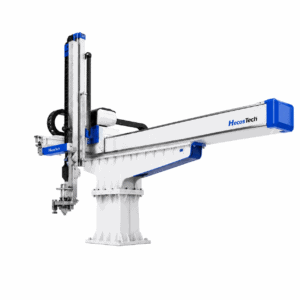
Use the in-mold labeling robot page when the immediate requirement is equipment or model-range selection for label placement and product handling. Use the IML automation for injection molding guide when the reader needs a broader explanation of how label handling, molding, takeout and downstream work are coordinated. This checklist helps a buyer prepare the inputs for those two discussions; it does not replace either page.
Sequence questions to document
- How will labels be supplied, presented and made ready for pickup?
- What mold-side placement and release conditions must the system accommodate?
- How is the molded product expected to be removed or transferred after the cycle?
- Does the project require stacking, conveying, inspection, packing or another downstream step?
- What happens when a condition needs operator attention, such as label replenishment or a planned restart?
Include downstream handling and the factory conditions
Automation scope can be incomplete when the project stops at mold opening. A product may still need a defined path for transfer, cooling time, stacking, conveying, inspection or packing. The project brief should state the intended downstream destination and any constraints that are already known.
Factory conditions are equally useful to record. Available floor space, access for maintenance, site utilities, safety expectations and the preferred enquiry contact all help a technical discussion start with the right questions. Record unknowns as open items; do not turn them into assumed requirements.
Turn the inputs into a short project brief
A concise project brief is more useful than a long list of disconnected questions. It can be one document containing the current product information, label information, mold status, injection molding machine details, sequence diagram, downstream need and open decisions. The goal is not to finalize every engineering detail before speaking to a supplier. The goal is to make the assumptions visible so each party can identify the next technical questions.
A practical IML automation project brief
| Section | What to include |
|---|---|
| Product | Drawing, sample or photos; dimensions; application; known material information |
| Label | Drawing or sample; format; intended placement; open handling questions |
| Mold | Existing/concept status; cavity and access information; interfaces requiring review |
| Machine | Model and available documentation; installation and interface context |
| Automation | Label pickup, placement, takeout and downstream sequence |
| Factory | Available space, utilities, safety/site constraints and maintenance access |
| Open items | Assumptions that need confirmation before the project scope is finalized |
Separate an initial review from a final commitment
Early project discussions often begin before every drawing, label sample or machine detail is final. That is normal. The important step is to distinguish confirmed inputs from assumptions that still need review. A project scope becomes stronger when the product, label, mold, machine and automation interfaces are considered together instead of being defined independently.
For a project-specific discussion, contact HecosTech with the information that is currently available. A clear brief gives the discussion a better starting point and helps identify which technical inputs need to be clarified next.
Frequently asked questions
What information is needed to start an IML automation project discussion?
Start with the product drawing, sample or clear photos; the available label information; the mold status; the injection molding machine details; the desired handling sequence; and the factory conditions that are already known. Mark any unconfirmed input as an open item.
Can an existing injection molding machine be considered for an IML project?
Yes, an existing machine can be part of the technical review. Provide the machine model and the relevant available information so the mold, robot access, interface and installation conditions can be evaluated together.
Do I need a final mold and label design before contacting a supplier?
No. Preliminary product, label and machine information can support an initial discussion. Final technical scope should distinguish confirmed data from items that still need review or approval.
Is an IML robot the same as a complete IML automation project?
No. A robot may address label placement and product handling, while a complete project can also involve the mold, injection molding machine integration, label supply and downstream handling. The required scope depends on the project brief.
What should be compared when reviewing IML proposals?
Compare the stated project assumptions and included interfaces, not only the equipment name. Check whether the product, label, mold, machine, automation sequence, downstream handling and site conditions are addressed in the same scope.
Start with the available project inputs
Share your product, label, mold or machine information with HecosTech to begin a technical IML project discussion.