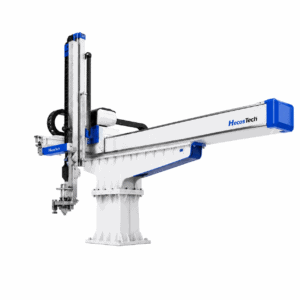
Match takeout, label placement and downstream handling requirements to the correct robot configuration.
An injection molding robot typically removes molded products from the open mold and transfers them to a conveyor, stacking station or downstream process. An IML robot performs additional operations: it picks a label, places it accurately inside the mold before injection and can remove the finished labeled product after molding.
A standard takeout robot should not automatically be treated as an IML robot. In mold labeling also requires coordinated label feeding, electrostatic or vacuum retention, customized end-of-arm tooling, accurate mold positioning and communication with the injection molding machine.
The correct selection depends on the required movements rather than simply choosing the robot with the most axes. Product geometry, mold structure, label position, cavities, target cycle time and downstream handling determine whether a 3-axis, 4-axis or 5-axis configuration is appropriate.
Injection Molding Robot and IML Robot Perform Different Tasks
A conventional injection molding robot is mainly configured for product takeout. After the mold opens, the robot enters the mold area, grips or holds the molded part, exits safely and transfers the product to the required position.
An IML robot must coordinate operations both before and after injection. It picks and separates a label, transfers it into the mold, positions it on the required surface and exits before the mold closes. The robot may also remove the completed product during the same mold-open period.
This process requires more than changing the robot program. The robot structure, travel, tooling, label magazine, static or vacuum system, machine signals and safety sequence must all support the IML process. A takeout robot can only become part of an IML automation system after these conditions have been technically evaluated.
How to Select a 3-Axis, 4-Axis or 5-Axis Robot
A 3-axis injection molding robot is suitable when the production process mainly requires mold entry, product takeout, transverse transfer and placement. It is commonly evaluated for clearly defined takeout operations without complex label insertion or product orientation.
A 4-axis IML robot provides an additional controlled movement for coordinating label pickup, mold entry, product takeout and placement. It can be configured for plastic container production where repeatable label positioning and automatic product removal are required.
A 5-axis IML robot offers greater motion flexibility for projects involving additional product orientation, transfer movements or more complex downstream placement. However, more axes do not automatically produce a faster cycle. Robot travel, tooling weight, mold-open time and the complete automation sequence must be evaluated together.
HecosTech HT3, HT4 and HT5 Robot Applications
The HecosTech HT3-900T is a 3-axis servo takeout robot designed to coordinate mold entry, product gripping, mold exit, transverse transfer and placement. It can be customized according to the molded product, mold, injection molding machine and downstream process.
The HT4-13S is a 4-axis IML robot developed for automatic label insertion and product takeout. For applications requiring additional orientation or coordinated multi-step handling, the HT5-12D provides a 5-axis servo configuration.
These examples describe HecosTech robot configurations and are not a universal rule that every IML application requires four or five axes. Final selection must be based on the actual product, mold, label, injection molding machine, cycle target and production layout.

Not Sure Which Robot Configuration You Need?
Send us your product drawing, mold information, injection molding machine model, label specifications and target cycle time. HecosTech engineers will determine whether your project needs a takeout robot, an IML robot or a customized automation cell.
Which Injection Molding Robot Fits Your Production Line?
If the required process only involves removing a molded product and transferring it to a fixed position, a 3-axis takeout robot may provide the necessary motion without adding unnecessary complexity.
If the robot must pick labels, place them inside the mold and remove finished labeled products, the project requires an IML configuration with suitable label feeding, tooling and retention equipment. A 4-axis or 5-axis IML robot can then be evaluated according to the required movements.
HecosTech robots can be adapted to all injection molding machine brands, but the final configuration must still be engineered around the actual machine, mold and factory layout. During evaluation, engineers should confirm platen dimensions, tie-bar spacing, mold opening stroke, ejector sequence, robot mounting position, available ceiling and floor space, end-of-arm tooling load, safety guarding and downstream transfer height.
Robot selection should not be based only on machine tonnage or axis quantity. A robot with additional axes is useful only when those movements are required for label insertion, product orientation, stacking, inspection or transfer.
The machine control interface and mold-open window must also support the planned robot sequence without creating an avoidable production bottleneck. The complete production process determines the correct solution and whether an existing line can be upgraded without unnecessary equipment changes.
Injection Molding Robot FAQ
Can a Standard Injection Molding Robot Perform In Mold Labeling?
Not automatically. The robot must have suitable motion, travel, control and mold clearance, together with a label magazine, customized tooling, electrostatic or vacuum retention and coordinated injection molding machine signals. These conditions must be evaluated before a takeout robot is used in an IML system.
Is a 5-Axis IML Robot Always Better Than a 4-Axis Robot?
No. A 5-axis robot is useful when the process requires additional orientation, transfer or complex placement movements. If a 4-axis system can complete the required sequence reliably, adding another axis may increase cost and programming complexity without reducing cycle time.
What Information Is Needed to Select an Injection Molding Robot?
Provide the product dimensions and weight, mold drawing and cavities, injection molding machine brand and model, takeout direction, current and target cycle time, factory layout and downstream operations. For an IML project, also provide the label drawing, material and required labeling position.
Whether you need automatic product takeout or a complete IML production cell, HecosTech can configure the robot, tooling, machine communication and downstream handling around your actual production requirements.
Send your project information to receive a technical evaluation and customized proposal.