
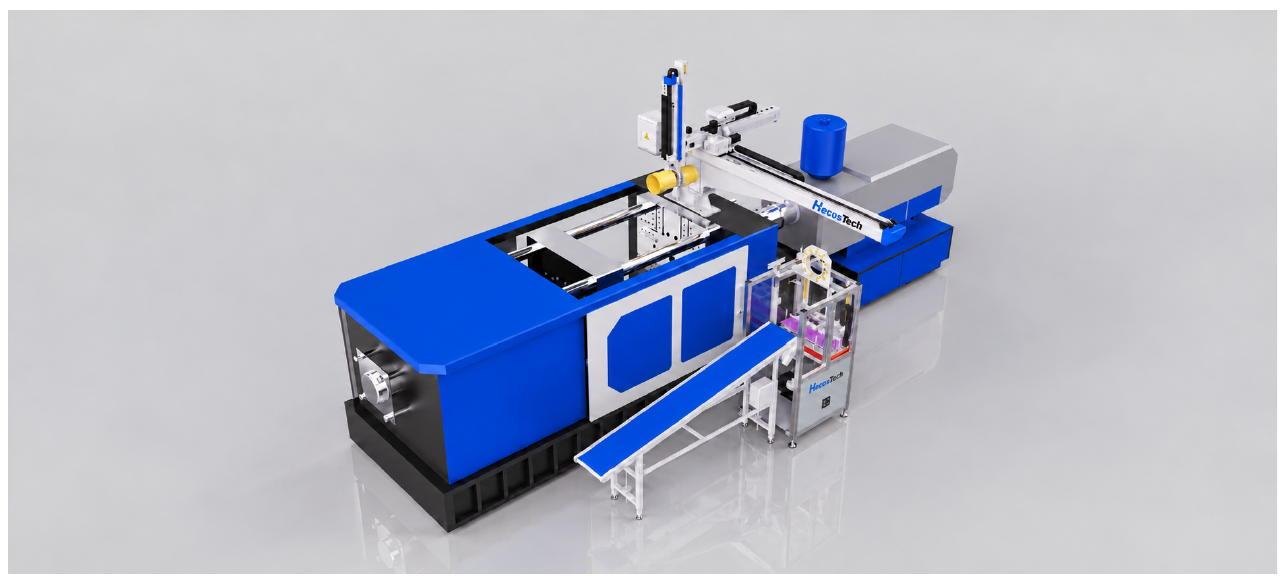
Description
HT-14PDA model and project scope
HT-14PDA is listed in the HecosTech brochure as an in-mold labeling system. Use its printed configuration, travels and component dimensions to prepare a model-specific label-insertion and takeout review. Confirm the supplied configuration against the current project drawing before ordering.
Product illustration: HT-14PDA brochure illustration. The image identifies the brochure model, not a delivered customer project or an approved installed layout.
Brochure technical specifications
Brochure reference: HecosTech company brochure, printed PAGE/07 (PDF page 5). Values below retain the source field definitions. Pending or unclear fields are omitted; confirm the current drawing and supplied configuration for the order.
| Parameter | Brochure reference |
|---|---|
| Electrostatic mode | In-mold + outside-mold |
| Electrostatic voltage | 20 kV |
| Equipment length A | 3,850 mm |
| Equipment width B | 1,750 mm |
| Equipment height C | 1,950 mm |
| Effective transverse travel D | 2,700 mm |
| Effective kick stroke E | 950 mm |
| Effective arm travel | 1,400 mm |
| Standby position: tooling center F | 340 mm |
| Minimum gap G, as printed | 40 mm |
| Label-magazine dimensions H × L × J, source order | 2,350 × 1,400 × 1,150 mm |
| Package length K | 600 mm |
| Maximum transverse and kick speed | 1 m/s |
| Maximum arm speed | 2 m/s |
| Fixture rotation | Cylinder / servo motor |
| Fixture label-pickup method | Vacuum pump |
| Arm type | Two-stage arm |
| Injection-molding-machine range, brochure reference | 350–750 T |
| Drive mode and coordinates as printed | Servo motor; coordinates X/Y/Z |
| Maximum load, brochure reference | 20 kg |
| Unloaded takeout / labeling time | 2.5 s |
| Dry cycle time | 10 s |
| Air consumption | 20 NL/cycle |
| Power supply | AC 380 V |
| Power capacity | 4 kVA |
| Robot equipment weight | 550 kg |
| Label-magazine equipment weight | 300 kg |
| Label-magazine capacity | 1,000 sheets |
The fixture-rotation row states cylinder / servo motor. Confirm which option is supplied and the required rotation range and tooling; this wording does not establish one fixed servo-axis configuration.
Machine, mold and labeling review
- Machine and mold: Provide the machine make/model and actual machine and mold drawings, mounting references, mold-open/ejector sequence and proposed access path. The brochure machine range is a selection reference, not machine/mold approval.
- Product, label and magazine: Provide the molded-product and label references, placement position, cavity arrangement and magazine access requirements. Fixture-volume and dedicated/general-purpose descriptions are brochure references, not approval of the complete labeling cell.
- Moving load and EOAT: Identify the product and tooling masses separately and ask how the quoted maximum load is defined, including any end-of-arm tooling allowance and load distribution. The printed maximum is not established net product payload.
- Installation and access: Locate the equipment and label magazine separately on the project layout. Equipment dimensions and weights do not establish installed clearance, guarding or service access. Confirm drawing datums and any F/G callouts that apply.
- Interfaces and handoff: Define the machine signals, sequence, safety/interlock responsibilities and receiving operation. Identify who supplies and integrates each machine, mold, tooling and downstream item; inclusion and interface approval must be stated in the project scope.
Timing and acceptance conditions
Maximum speeds, minimum or unloaded times and dry-cycle values, where printed, retain their individual definitions in the table. They are brochure references, not the production cycle of a loaded machine/mold/robot cell. Agree the actual configuration, representative samples, operating conditions and acceptance criteria before relying on a target output. This page does not record a completed trial, FAT or customer acceptance.
Compare HT-14PDA and HT-14PDF Motion References
The brochure lists 1,400 mm arm travel for both models. That shared value does not make their transverse D and kick E entries equivalent. Match each movement to the proposed mold-entry, label-placement and takeout path before choosing between them.
| Effective travel | HT-14PDA | HT-14PDF |
|---|---|---|
| Transverse D | 2,700 mm | 2,600 mm |
| Kick E | 950 mm | 1,080 mm |
| Arm travel | 1,400 mm | 1,400 mm |
References: HecosTech brochure, printed PAGE/07 and PAGE/08 (PDF pages 5 and 6). HT-14PDA has the larger printed D entry, while HT-14PDF has the larger E entry. Mark the required movements separately on the proposed drawing; extra travel in one direction does not replace a required movement in another.
Keep the Timing Definitions Separate
HT-14PDA has one combined unloaded takeout / labeling time: 2.5 s entry. HT-14PDF lists in-mold unloaded takeout: 0.8–2 s, small-frame labeling: 1.8–2.8 s and large-frame labeling: 2.5–4 s. Retain those source labels and identify which proposed tooling and operation each quoted time covers. The two labeling entries are not additionally described as unloaded.
These different fields do not establish a model-speed ranking or a complete production cycle. Compare the same actual operation, start/end states and agreed conditions. Keep molded-sample approval separate from acceptance of the robot motion and integrated timing sequence. Bring the marked motion drawing, timing definitions and open trial conditions to the machine and mold integration review. Use the full IML model comparison for the wider shortlist, then the engineering proposal review below for the actual project.
Compare named models and define the project
Compare HT-16PDA and HT-14PDF. Review each named model’s travels, dimensions, load definition and supplied tooling; a shared family or similar value does not establish interchangeability.
Return to IML robot selection for the wider task scope. Send the shortlisted model, drawings, product/label references and unresolved configuration questions for an engineering proposal review.