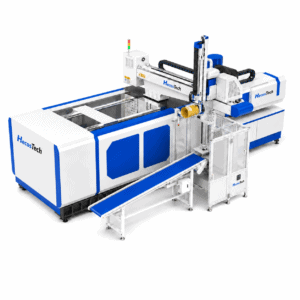
Confirm machine, mold, interface and cycle compatibility before your IML robot is manufactured.
An IML robot for injection molding machine integration must be engineered around the actual machine, mold and production sequence. The injection molding machine brand and clamping force provide useful initial information, but they are not enough to confirm the robot configuration.
The robot must have sufficient access to place labels and remove molded products without interfering with the mold, ejector or machine movements. Its motion must also fit within the available mold-open time and communicate correctly with the injection molding machine.
HecosTech IML robots can be adapted to all injection molding machine brands and support EUROMAP 12 and EUROMAP 67. Final compatibility must still be confirmed from the actual machine specifications, interface documentation, mold and required automation sequence.
What Must Match Before IML Robot Integration?
Mechanical matching begins with the actual injection molding machine and mold. Important information includes platen dimensions, tie-bar spacing, mold-opening stroke, mold height, ejector position and sequence, robot mounting position, available floor space and overhead clearance.
The production process must also be reviewed. Product dimensions and weight, label size and position, mold cavity quantity, target cycle time, end-of-arm tooling and required downstream operations all influence robot travel, payload and motion sequence.
Electrical integration requires the correct connector, signal arrangement, safety circuit and operating logic. Before manufacturing begins, the supplier should review the machine model, technical documentation and interface configuration instead of assuming that every machine from the same brand uses an identical setup.
How EUROMAP 12 and EUROMAP 67 Support Integration
EUROMAP 12 and EUROMAP 67 define electrical interfaces between an injection molding machine and a handling device or robot. They provide standardized signal communication so the injection molding machine and IML robot can coordinate their movements during the production cycle.
These interfaces help manage operating permissions and machine status during mold opening, label placement, product takeout and robot clearance. The correct sequence is essential because the injection molding machine must not begin a conflicting movement while the robot is inside the mold area.
However, EUROMAP 12 or EUROMAP 67 support does not automatically confirm complete project compatibility. Mechanical dimensions, connector configuration, signal assignment, safety requirements, machine options and cycle logic must still be checked against the actual injection molding machine.
IML Integration Across Global Injection Molding Machine Brands
IML automation can be integrated with injection molding machines from different countries and manufacturers. Representative market examples include China’s YIZUMI PAC380K3 for high-speed packaging production, Austria’s ENGEL e-speed 280 for an IML yogurt-container application, and Germany’s ARBURG ALLROUNDER 720 A for thin-wall IML cup production.
These models are reference examples showing that packaging and IML automation are used across different machine platforms. They do not represent a limited compatibility list, a claim that HecosTech supplied these published demonstration cells, or automatic approval for every machine of the same model.
For a HecosTech project, final matching is based on the customer’s actual injection molding machine, mold, product, label, target cycle and factory layout. This allows the IML robot, tooling, interface and operating sequence to be configured for the real production conditions.

Confirm Your Injection Molding Machine Before Manufacturing
A properly configured IML robot for injection molding machine production starts with verified machine and mold data. Send HecosTech the machine brand, exact model, technical specifications, mold drawing, product information and required cycle before confirming the robot.
This engineering review helps identify mechanical, electrical and process requirements before the system enters manufacturing.
Can You Retrofit an IML Robot to an Existing Injection Molding Machine?
An IML robot for injection molding machine production can often be installed as an IML robot retrofit on an existing machine, provided that the machine, mold, interface, production cycle, and available installation space meet the project requirements.
Before deciding whether to retrofit an IML robot to an existing injection molding machine, the review should confirm mold access, platen and tie-bar dimensions, opening stroke, ejector sequence, robot mounting position, production cycle, and available communication signals. Older machines or machines without a suitable standard interface may require additional electrical work, signal conversion, or customized integration.
Before an IML robot retrofit or IML robot upgrade is approved, the existing mold must also be checked for label placement, product takeout, and robot clearance. The final technical proposal should also confirm the destination country’s voltage, frequency, safety requirements, installation conditions, and the equipment that can remain in the upgraded production cell.
HecosTech IML robots can be adapted to all injection molding machine brands. However, every retrofit must be evaluated from the actual machine and production conditions rather than approved from the brand name alone.
IML Robot Integration FAQ
What Is the Difference Between EUROMAP 12 and EUROMAP 67?
EUROMAP 12 and EUROMAP 67 are separate electrical interface recommendations for communication between an injection molding machine and a handling device or robot. The interface actually installed on the machine must be identified before wiring and programming are confirmed.
Choosing an IML robot for injection molding machine integration therefore requires the supplier to verify the connector, signal configuration, safety circuit and required operating sequence.
Can an IML Robot Work With Any Injection Molding Machine Brand?
HecosTech IML robots can be adapted to different injection molding machine brands. Final compatibility depends on the actual model, mechanical dimensions, mold, interface, cycle time, installation space and production process.
Brand compatibility does not mean that one standard configuration fits every machine. An IML robot for injection molding machine production must be configured from the actual project data.
What Machine Information Is Required for IML Robot Integration?
Provide the injection molding machine brand and exact model, clamping force, platen dimensions, tie-bar spacing, mold-opening stroke, ejector information, interface type, technical manual, current cycle time and factory layout.
The product drawing, label drawing, mold drawing, cavity quantity and required downstream operations are also needed because the robot must be matched to the complete production process.
Planning an existing injection molding machine automation or IML robot retrofit project? Send HecosTech your machine model, mold, product, label, current cycle, interface, and automation requirements. HecosTech can evaluate the existing equipment and confirm the mechanical layout, EUROMAP 12/67 interface, operating sequence, and required upgrade scope before manufacturing.
For cell integration: the in-mold labeling mold must be considered alongside the robot interface, label handling and injection molding machine.