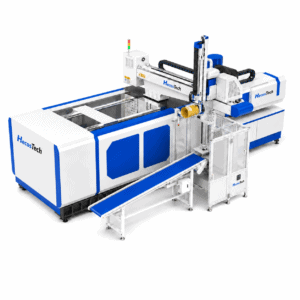
In-mold labeling (IML) combines label placement, plastic molding, and automated part handling in one production cycle. An IML robot places the label accurately inside the mold and can also support product takeout, stacking, and downstream automation.
An in mold labeling robot is an automated system used to place pre-printed labels accurately inside a mold before the plastic product is formed. During injection molding, the label bonds with the plastic and becomes an integrated part of the finished product, eliminating the need for a separate post-molding labeling process.
How Does In-Mold Labeling Work?
In-mold labeling starts before the plastic product is formed. A pre-printed IML label is prepared and picked up by the IML robot, which moves the label into the open mold and positions it at the required location.
After the label is held in position, the mold closes and the injection molding process begins. The molten plastic forms against the label, bonding the label to the surface of the product during molding. When the mold opens, the finished product can be removed by the robot and transferred to stacking, conveying, inspection, or other downstream automation.
What Does an IML Robot Do?
An IML robot automates the handling steps required before and after injection molding. Its primary task is to pick up the prepared label, enter the mold area, and position the label accurately inside the mold before the molding cycle begins.
Depending on the automation configuration, the robot can also remove finished products, separate parts, stack containers, transfer products to conveyors, and work with inspection or other downstream equipment. This allows multiple handling operations to be integrated into one automated production system. For readers evaluating equipment options, review the in mold labeling robot page for the available robot range and configuration considerations.

IML Automation Trends
IML automation is moving toward more integrated and flexible production systems, combining label placement, product takeout, stacking, conveying, and inspection in one process. Customized automation is also becoming more important as packaging formats and production requirements become more diverse. Flexible IML systems can help manufacturers adapt automation to different products, molds, and production needs.
Main Components of an IML System
1. IML Robot
The IML robot handles label pickup, mold entry, label placement, finished-product takeout, and other automated handling tasks according to the production cycle.
2. Label Feeding System
The label feeding system prepares and presents individual labels so the robot can pick them up consistently and transfer them to the mold.
3. Injection Mold
The IML mold must support reliable label positioning, product molding, cooling, and release.
4. IML Labels
IML labels must match the product design, mold, printing requirements, and molding process. Label dimensions, artwork, material, and positioning need to be confirmed before production.
5. Handling and Inspection Equipment
Depending on the project, the automation system can include conveyors, stacking units, product orientation devices, and visual inspection equipment for downstream handling and quality control.
Applications of IML Robots
IML robots are widely used for injection molded packaging where accurate label placement, repeatable handling, and automated product takeout are required. Typical applications include food containers, dairy packaging, cups, tubs, lids, pails, buckets, household packaging, and other injection molded plastic products.
The automation configuration depends on the product shape, mold structure, label size, injection molding machine, cycle requirements, and downstream handling process. For this reason, an IML robot system is normally configured around the specific product and production requirements rather than as a universal standard solution.
How to Choose an IML Robot System
Choosing an IML robot system starts with the product and production process. Important factors include container dimensions, label specifications, mold layout, injection molding machine configuration, required cycle time, product takeout method, stacking or conveying requirements, and any inspection or downstream automation. A properly configured system should coordinate the robot, IML mold, labels, and handling equipment as one complete production process.
Frequently Asked Questions About In-Mold Labeling
What does IML stand for?
IML stands for in-mold labeling, a process in which a pre-printed label is placed inside the mold before the plastic product is formed.
How does in-mold labeling work?
An IML robot picks up the label and places it inside the open mold. The mold then closes, plastic is injected, and the label bonds with the product during molding.
What does an IML robot do?
An IML robot can handle label pickup, mold entry, label placement, product takeout, stacking, conveying, and other automation tasks depending on the production system.
What products are suitable for in-mold labeling?
Typical applications include cups, tubs, lids, food containers, dairy packaging, pails, buckets, household packaging, and other injection molded plastic products.
What information is needed to plan an IML automation system?
Useful information includes product drawings or samples, container dimensions, label specifications, mold information, injection molding machine details, required cycle time, factory layout, and downstream handling requirements.
Share your product, mold, label, injection molding machine, and production requirements with HecosTech. Our team can help evaluate your application and recommend a suitable IML automation solution.
For equipment selection: review our in-mold labeling robot options when matching the robot to the mold, label format and injection molding cell.